Newsletter #119

On 2026-03-05

In Newsletters (International)

March 2026
In this edition’s highlights: is Renault stock undervalued?

Note: To print this bulletin or save it in PDF format, right‑click on the page and select “Print…” from the menu.

Next Annual General Shareholders’ Meeting of the Renault Group: April 30, 2026

Dear fellow employee and former employee shareholders,

Despite the announcement of strong financial results for 2025 and the dividend being maintained at the same level as last year, Renault’s share price remains stagnant at around €30. This situation is primarily due to a general lack of confidence in the automotive sector, which is affecting all manufacturers indiscriminately.

In this Bulletin, you will find several comparative tables clearly illustrating the current undervaluation of Renault’s share compared with other CAC 40 companies (France’s 40 largest listed companies).

The announcement of the new strategic plan on March 10, the main pillars of which have already been presented through internal communications, will set a clear direction for the coming years. However, it is not certain that this announcement alone will be enough to dispel the markets’ current caution.

In this context, the next employee share ownership plan could represent an attractive opportunity.
If the share price remains stable for a few more weeks, it would be possible to acquire shares at a 30% discount, at a price level comparable to that of the 2022 plan (€22). For those who subscribed at that time, the payment of a €2.20 dividend in 2024 and 2025 corresponds to a 10% yield.

This year, 36 resolutions will be submitted to shareholders for a vote at Renault’s Annual General Meeting on April 30.
They are already available online (Renault AGM Resolutions). The Association’s position will be communicated in the next Bulletin, at the beginning of April.

This busy news agenda once again illustrates the vitality and importance of employee share ownership at Renault.

Enjoy the read,

C. Quintard, President of the AASR
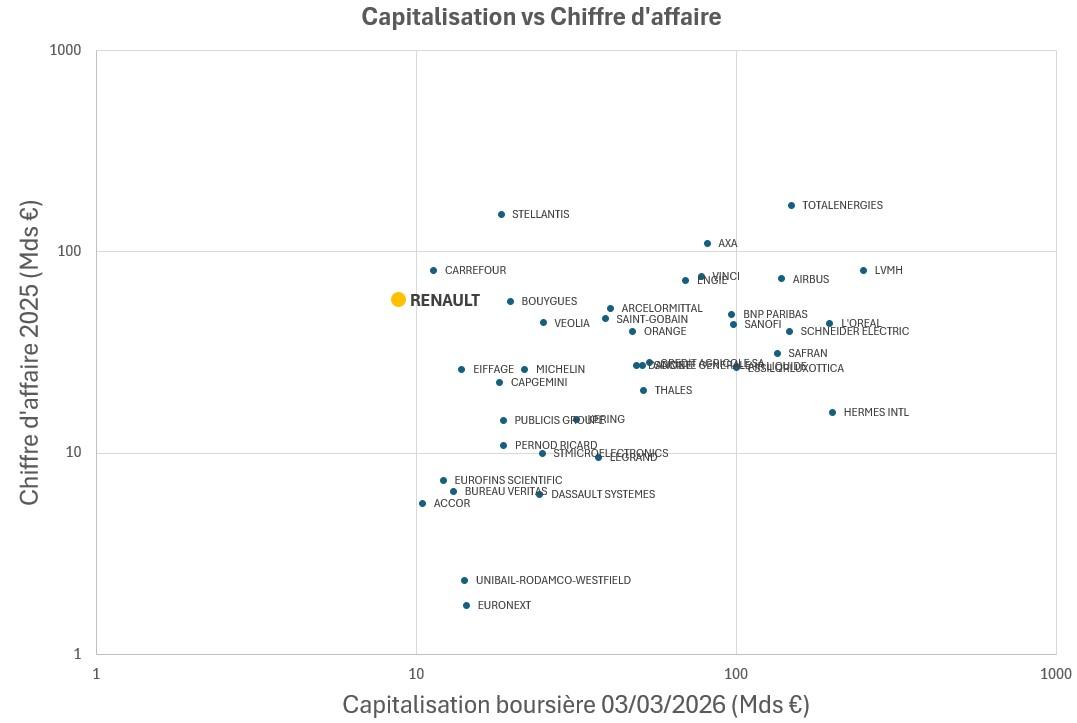
Chart 1: Market capitalizations of the CAC 40


Capitalization vs annual turnover

119g1

What is market capitalization?

Market capitalization is the total stock market value of a company. It is calculated simply as follows:

Market capitalization = share price × total number of shares outstanding

It therefore represents a company’s financial size as seen by the market. The higher it is, the more the company is perceived as important, stable, or dominant within its sector.

Renault’s market capitalization is approximately €8.8 billion.

What does this chart show?

The chart ranks CAC 40 companies from the largest to the smallest market capitalization:

  • At the top of the ranking: very large global companies such as LVMH (≈ €250bn), Hermès (≈ €200bn), and L’Oréal (≈ €196bn).
  • In the middle: a broad range between €20bn and €90bn, corresponding to the “core” of the CAC 40.
    • The median market capitalization of the index is around €36.4bn.
  • At the bottom of the ranking: the smallest companies in the index, including Renault, Carrefour, and Accor.

How should this situation be interpreted?

  • A small market capitalization does not mean that the company is small in reality: Renault generates €56bn in revenue, more than many companies with much higher valuations.
  • Market capitalization instead reflects:
    • market confidence,
    • perceived profitability,
    • sector risk (the automotive industry is cyclical and highly capital‑intensive),
    • expectations for the future (transition to electric vehicles, global competition, lower margins).

As a result, Renault appears to be an industrially significant company, but undervalued on the stock market compared with the majority of CAC 40 companies.

Chart 2: Estimated returns in 2026

119g2

What is yield?

A stock’s yield corresponds to the dividend relative to the share price:

Yield = dividend / share price

In other words, it represents the “immediate return” an investor receives in the form of dividends. A high yield often attracts income‑focused investors, provided the dividend is considered sustainable.

What does the chart show?

The estimated yield of CAC 40 companies in 2026 varies widely:

  • The median is around 3.19%.
  • Most companies fall between 1% and 6%.
  • A small group exceeds 6%: Carrefour, Renault, Crédit Agricole, AXA, Pernod Ricard, BNP Paribas.

How should a high yield be interpreted?

  • A high yield can be attractive,
    but it is not automatically good news.
  • It may indicate:
  1. that the company is paying a high dividend,
  2. or that the share price is low, which mechanically increases the ratio.

In Renault’s case, it is mainly the relatively low share price (around €30 in early March 2026) that pushes the yield higher. As a result, depending on investors’ views, a high yield may reflect an opportunity… or a perceived risk.

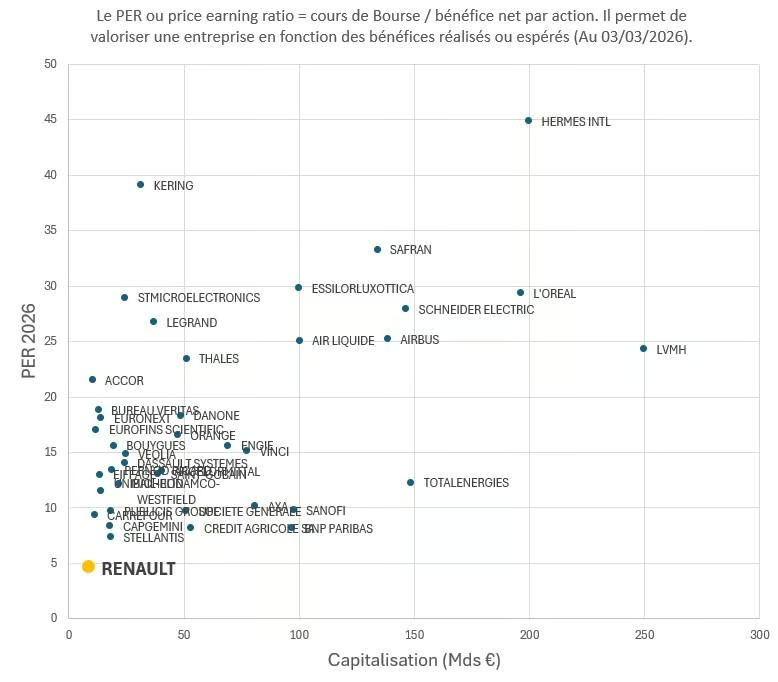
Chart 3: PER 2026

2026 P/E ratio vs capitalization

119g3

What is the P/E ratio?

The P/E ratio (Price‑Earnings Ratio) compares:

P/E = share price / earnings per share (EPS)

[EPS (Earnings Per Share) corresponds to the company’s net profit divided by the number of shares outstanding. It indicates how much profit is attributable to each share.]

It is a widely used indicator to assess how much investors are willing to pay for €1 of earnings.

  • High P/E → the market expects strong growth or considers the company very solid.
  • Low P/E → the market expects limited growth or views the company as risky.

The P/E ratio is therefore a barometer of market confidence.

What does the chart show?

  • The median P/E of the CAC 40 is ≈ 12.79.
  • “Premium” sectors (luxury, technology, healthcare) have high P/E ratios.
  • The bottom of the ranking mainly includes automotive, banking, and energy companies.

Renault shows an estimated 2026 P/E of ≈ 5, making it the lowest P/E in the CAC 40.

How should such a low P/E be interpreted?

A very low P/E can have two opposite interpretations:

1. Negative view (market caution)

  • The market may believe that future earnings will be uncertain or volatile.
  • The automotive sector is considered cyclical and faces:
    • the transition to electric vehicles,
    • intense international competition,
    • margins that are often lower than in other sectors.
       

2. Positive view (a “cheap” stock)

  • A low P/E may indicate that the stock is undervalued,
  • and therefore could be re‑rated if earnings become more stable or improve.

Information about the Association

Newsletter distributed by email upon request at aasr@renault.com or by clicking on "Contact" at the top of the page

Visit our website: www.aasr.website

Follow us on LinkedIn: aasr-renault

To manage your FCPE

Intranet : Life@Renault

Internet : Employee stock ownership - Renault Group


BNP E&RE (Renault Company saving plans manager) :

Internet : My Company Savings

Phone : from France : 0 969 320 429 / from other countries : +33 3 28 76 33 47 (french/english) or +33 1 45 23 00 10 (spanish)